

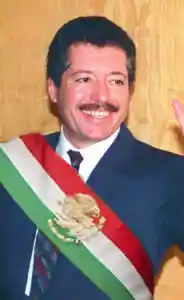

A former Mexican intelligence operative has been apprehended in connection with one of the most traumatic moments in the country’s political history — the 1994 assassination of presidential frontrunner Luis Donaldo Colosio.
Jorge Antonio Sánchez Ortega, once linked to Mexico’s top intelligence agency during the 1990s, was taken into custody over the weekend in Tijuana, Baja California. He has since been presented before a judge, reigniting long-standing questions around the killing that many believe was never fully solved.
Colosio, the charismatic candidate of the long-ruling Institutional Revolutionary Party (PRI), was gunned down at close range during a campaign stop in Tijuana on March 23, 1994. His death rocked the nation and marked a turning point in the political trajectory of modern Mexico. Only weeks before the attack, Colosio had publicly denounced corruption within his own party, a move that isolated him from entrenched power blocs and may have made him a target.
Although a lone suspect — Mario Aburto Martínez — was arrested and convicted shortly after the shooting, doubts about the official version have persisted for decades. Many Mexicans have likened the case to the assassination of John F. Kennedy in the United States: a high-profile killing, a swift conviction, and an enduring belief that deeper forces were at play.
Sánchez Ortega, who was reportedly employed by Mexico’s now-defunct Center for Investigation and National Security (CISEN) at the time of the assassination, had previously been detained in the immediate aftermath but was released within 24 hours. His name has lingered on the periphery of the case ever since.
Authorities have not disclosed what prompted his sudden re-arrest nearly three decades later, and it remains unclear if fresh evidence has surfaced. However, his renewed involvement is likely to fuel speculation that the true story behind Colosio’s assassination has yet to be told.
Colosio’s death, coming during a moment of political fragility and economic turbulence, is widely considered a catalyst for reform within Mexico’s political establishment. The unresolved questions surrounding his murder remain a stain on the legacy of the PRI and a reminder of an era when state power operated in deep shadow.
The reappearance of figures tied to the original investigation suggests that Mexico’s reckoning with its past is far from complete.