

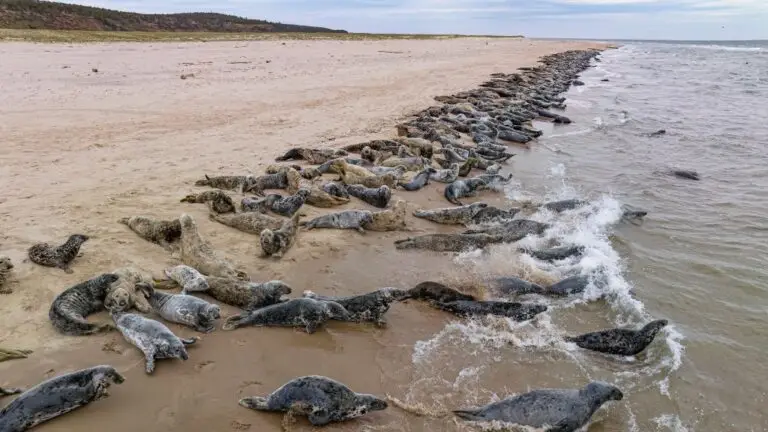

The world’s coldest frontier is no longer beyond reach—nor beyond ruin. Once protected by its remoteness, the Arctic has become the newest casualty of humanity’s endless expansion.
The Disappearing North
What was once a fortress of ice is now a battlefield of survival. Seals, seabirds, and countless other species that have thrived for millennia are being pushed toward collapse. The ice that once shielded them is thinning, retreating earlier each year, leaving open seas that amplify storms, waves, and human intrusion.
The hooded seal, once a sentinel of frozen oceans, now stands among the endangered. Its kin—the bearded and harp seals—follow close behind, trapped between dwindling ice and rising industrial noise. Ships now cross waters that were once silent, while mining and oil extraction grind into the seabed, chasing profits buried beneath melting ice.
Vanishing Wings
The Arctic’s crisis mirrors a broader tragedy unfolding across the tropics. Forests that once roared with birdlife are going silent. Expanding farmland and logging have erased critical habitats from Madagascar to West Africa. Researchers estimate that more than sixty percent of the world’s bird species are now in decline, a staggering rise from less than half just a decade ago.
Each fallen tree and drained wetland tightens the noose around entire ecosystems, reducing migration routes and breeding grounds once taken for granted. The loss is not only ecological—it’s architectural. Birds, like seals, are builders of balance. When they vanish, the structure beneath life itself begins to tilt.
Speed of Collapse
In the high north, change is now measured not in centuries or decades, but in winters. Scientists studying the Svalbard archipelago recall ice once thick enough to support travel for five months of the year—now gone. What was once frozen until May is today open water by February. “The transformation defies language,” one polar researcher remarked. “The Arctic isn’t changing; it’s dissolving.”
Flickers of Recovery
Not every story ends in decline. The green turtle, rescued from the brink by decades of coordinated protection, has made a modest but vital comeback. Its population has grown steadily since the 1970s—proof that deliberate, long-term conservation works. Yet even this rare success has been met with caution. Scientists warn that victories in one region cannot offset the scale of global loss.
A Narrowing Window
The Arctic’s unraveling is a message written in melting ice. What happens there will echo everywhere—from rising seas to disrupted weather patterns that ripple across continents. Humanity has breached every border, even those once thought untouchable.
The frozen frontier has fallen within our reach.
Now the question is whether we have the will to stop reaching.