
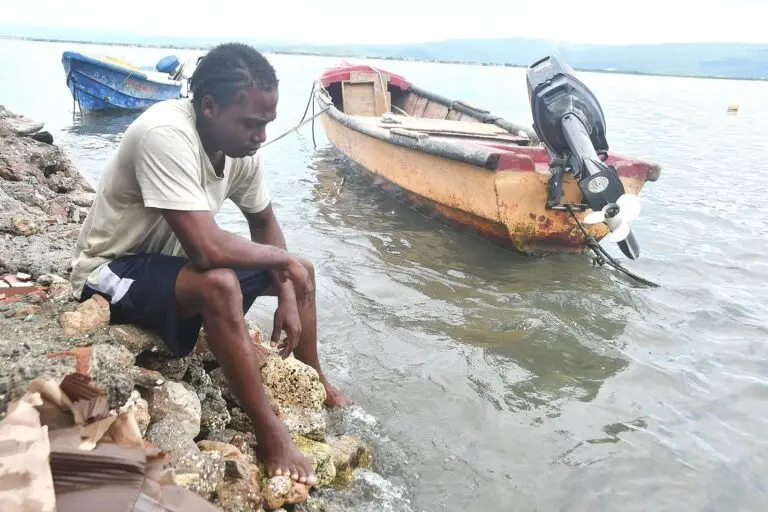

By the time the sun dipped below the horizon last Wednesday, calm waters had become a battlefield. What started as a routine journey for several seasoned fishermen took a sudden and violent turn miles off the Clarendon coast — a chilling prelude to the arrival of Hurricane Melissa.
The fishermen, mostly from Port Royal, had launched into the Caribbean on what they believed would be one of their final trips before the storm system brushed past the island. They were wrong. The storm didn’t wait. It came early — unannounced, unrelenting, and unforgettable.
“It came out of nowhere. The boat started shifting hard to the right, then the left — and the rain? You couldn’t even see your hand stretch out,” one fisherman recounted.
The wind had come in sharp, dragging the rain like needles across the open sea. Vision blurred. Nets tangled. Buoys disappeared under rushing waves. Then came the cold — the kind of cold that doesn’t belong in the Caribbean. A kind of cold that makes men think about what they left onshore.
Between Two Fronts
Fabian Simpson was among the crew who made the trek from Port Royal. A trip he’d made many times before. But as he described it, this time, the sea didn’t want them there.
“It was like two winds arguing. One from the land, one from the water — they met and just… exploded. I’ve seen rain and rough tides before, but this was different,” he said, shaking his head.
Their tarps tore. Anchors ripped loose. And all that was left to do was run.
As they steered through the darkness, only small specks of light — from scattered boats — reminded them they weren’t alone in the chaos. They navigated by memory and instinct. The weather forecast had suggested heavy rains by the weekend. But out here, forecasts don’t always keep their promises.
No Room for Complacency
For some, there was no retreat. Alan Williams, 68, chose to wait it out at sea. He couldn’t risk a blind return in lightning and zero visibility.
“We didn’t see land. Just lightning and water,” Williams said, his voice steady but his eyes distant. “So we stayed until light came. That was the safest thing we could do.”
Williams has been fishing for 50 years. But every storm, every gust, every close call still humbles him.
“We had to bail out the boat. The sea was coming in from both sides. But we made it,” he said simply.
Their reason for staying out was practical — gather enough catch before Melissa made landfall. They needed to stock up, earn, and prepare their families before the real storm arrived.
Survival is Skill + Prayer
Ian Brooks, another veteran, recalled how quickly instinct took over. Pull up the net. Secure the stern. Cut loose. Move.
“Once your anchor breaks and the wind grabs you, you either move or you flip,” he said. “So we moved. But we pray too. Out there, you pray hard.”
For men whose lives are tied to tides and forecasts, preparation is the difference between legend and obituary. And these men — many of whom never finished high school — are masters of survival science.
Lessons in Every Storm
They don’t see themselves as heroes. Just men with families, making hard decisions in unpredictable waters. But their story is a reminder — of nature’s power, of human resilience, and of the invisible line between routine and disaster.
Each one returned to shore, wet to the bone, exhausted — but alive.
“We give thanks. The sea didn’t take us this time. And next time, we’ll be ready again,” Williams said, eyes still scanning the horizon.
With Hurricane Melissa inching closer to the island, Jamaica now braces. But if anyone knows what it means to face the winds before the winds arrive — it’s these fishermen.