
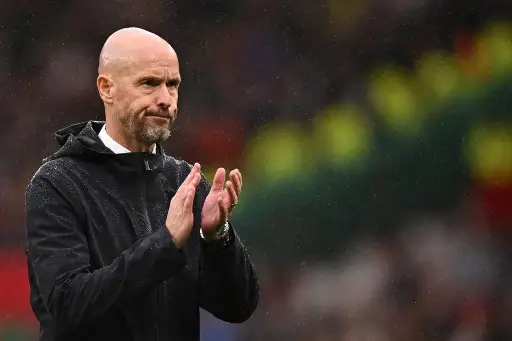

Bayer Leverkusen’s experiment with Erik ten Hag has collapsed almost as quickly as it started, a reminder of how unforgiving top-flight football has become in the post-Xabi Alonso era.
The Dutchman lasted just two Bundesliga fixtures, leaving behind more questions than answers. He was brought in to guide the German champions through a turbulent summer of departures and an ambitious rebuild, but the cracks showed from day one.
A Club in Transition
Leverkusen’s recent triumph—their first-ever Bundesliga crown and a historic double—set an impossibly high bar. When Alonso departed for Real Madrid, he left behind not just a trophy-laden side, but also a vacuum of identity. The departures of Florian Wirtz, Granit Xhaka, and several other pillars only deepened the uncertainty.
Ten Hag’s task was daunting: mold a squad rebuilt with more than a dozen signings, integrate record transfers, and keep the momentum alive. Instead, he struggled to imprint authority or consistency, and his players appeared caught between systems.
The Unforgiving Clock
Football’s revolving door of managers spun faster than ever in this case. Ten Hag now holds the dubious record of being dismissed earlier than any coach in Bundesliga history. In an age where patience is scarce and results are demanded instantly, he became a casualty of the very expectations his predecessors had created.
The numbers didn’t help: surrendering leads, leaking goals, and stumbling through early fixtures painted a picture of vulnerability that the board would not tolerate.
What This Signals for Leverkusen
The decision exposes the ruthlessness at the heart of modern football. Success is no longer a shield—it becomes a trap. Clubs that scale the peak find themselves terrified of sliding back down, and managers are often the first to pay for even the hint of decline.
For Leverkusen, the next appointment will be about more than results; it will be about identity. Ten Hag’s short-lived reign proved that continuity after glory is harder to engineer than glory itself.
And for the 55-year-old coach, it marks another abrupt end—first at Manchester United, now in Germany—fueling doubts about whether his once-rising reputation can recover.