
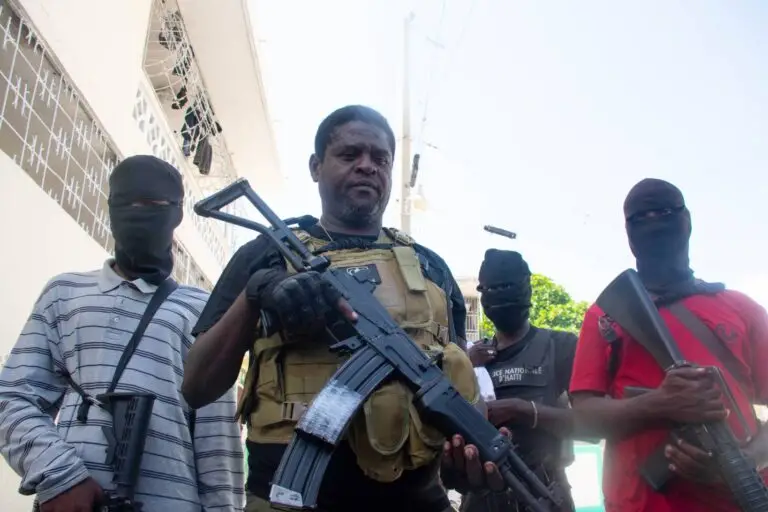

In Haiti’s fragile power grid, Jimmy “Barbecue” Chérizier remains both arsonist and fireman — accused of terrorizing neighborhoods while also positioning himself as a voice against lies and scapegoating. This week, the gang leader made a startling declaration: he is ready to cooperate with the FBI.
It was not a confession, nor a surrender. It was a performance.
Chérizier’s message, delivered in English, was aimed squarely at Washington. He insisted that Bazile “Fredo” Richardson — a Haitian-American currently jailed in Texas on charges of funneling money into Haitian gangs — is innocent. He accused U.S. prosecutors of fabricating connections and demanded “no lies” if any collaboration with the FBI is to occur.
For U.S. authorities, this statement comes against a backdrop of violence long linked to Chérizier. Indictments tie him to diaspora-funded weapons pipelines, massacres like La Saline in 2018, and a criminal structure that undermines Haiti’s already fractured governance. A $5 million bounty hangs over his name, yet he stands unbothered, issuing conditions to the same government hunting him.
The irony is sharp: a man branded a foreign terrorist now frames himself as a truth-teller, a potential ally — but only if his version of events is validated.
What Chérizier is doing is not simply pleading Richardson’s case. He is flexing narrative power. By shifting the spotlight, he portrays himself not as a fugitive, but as a negotiator who can set terms with the FBI. It is less about justice, and more about leverage.
Whether this is a prelude to negotiation, propaganda aimed at diaspora supporters, or just another move in a long game of survival, one fact remains: Chérizier is rewriting the script. And in Haiti’s ongoing collapse, whoever controls the script often controls the street.