
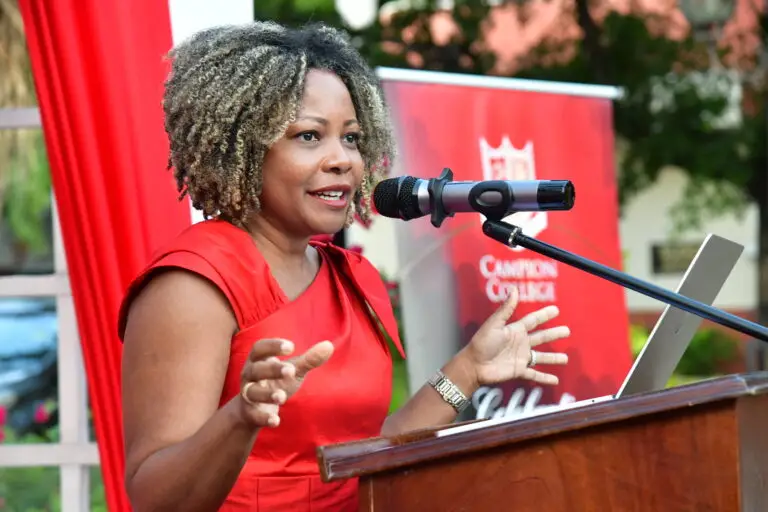

Jamaica’s educational crisis demands urgent attention, and Education Minister Dr. Dana Morris Dixon has emphasized that it is not just a government issue—it’s a national challenge. Speaking at a media briefing hosted by the Education Transformation Oversight Committee, Dr. Dixon called on every Jamaican to contribute to the urgent transformation of the nation’s education system.
The latest Caribbean Examinations Council (CXC) results show a troubling picture, with students continuing to struggle in crucial areas like mathematics and English. In 2022, Jamaica’s mathematics pass rate was 37.3%, and while there was a marginal increase to 38.9% in 2024, the numbers remain alarmingly low. English pass rates also saw a slight dip, from 77.2% in 2022 to 76.4% in 2024, further illustrating the lack of progress in fundamental subjects.
The Ministry has set ambitious targets for this year: 49% for mathematics and 80% for English. Achieving these goals will require a unified effort from every sector of society, from the government to the private sector and community organizations.
The Minister’s statement underscores an uncomfortable truth: the failures in education reflect a broader failure in our priorities. Education is more than just passing exams; it shapes the future of the nation. The continued underperformance in essential subjects points to a deeper societal issue—one that threatens to undermine Jamaica’s economic growth and development. Without a solid foundation in literacy and numeracy, our students will struggle to meet the demands of the workforce and higher education.
It is clear that the time for blaming individual parties has passed. Teachers, although working tirelessly, are often under-resourced and overburdened. Parents, many of whom are either overwhelmed or disengaged, are not sufficiently reinforcing the importance of education at home. The government’s role in policy and funding is pivotal, yet it has often failed to fully invest in the necessary reforms. Meanwhile, the private sector has largely remained an outside observer, with minimal investment in transforming education to meet the needs of the future.
To turn this situation around, Jamaica must implement systemic reforms that address the root causes of underachievement. This starts with adequate funding for schools, better training and support for teachers, and the integration of technology to create an engaging learning environment. But these changes cannot happen without a collective effort.
Parents must take responsibility for their role in fostering learning at home. Schools alone cannot shoulder the burden of education; the home environment is just as critical in shaping a child’s future. The private sector, too, has a crucial role to play. Businesses must invest in education initiatives that support both infrastructure and skills development. It is in the best interest of companies to ensure a well-educated workforce, and partnerships with schools could be a game-changer.
The community at large must stop being passive observers and start advocating for better education. The collective well-being of our society depends on how we support our children’s education today. As the saying goes, “It takes a village to raise a child”—and it will take all of us, working together, to ensure the future of Jamaica is bright.
Jamaica’s future workforce depends on the education system working effectively. Let us step up and create the change we need, for the sake of our children and the nation’s future prosperity.