
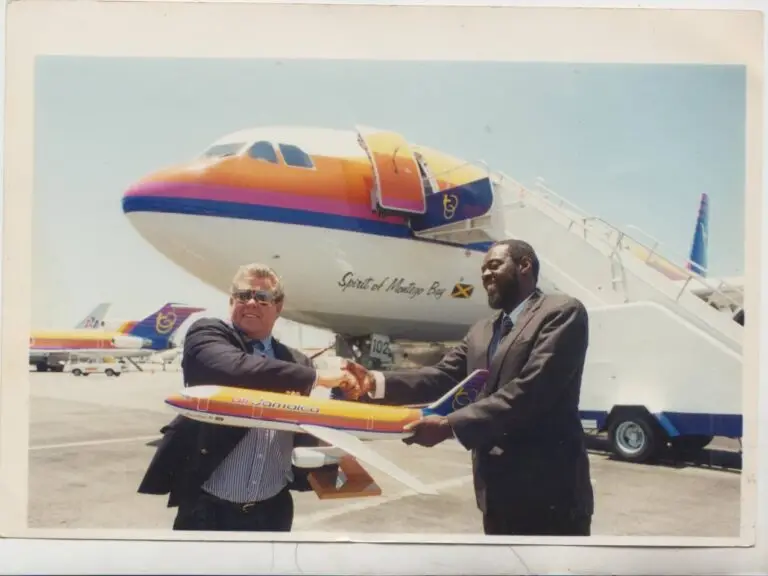

When Gordon “Butch” Stewart stepped in to rescue Air Jamaica in 1994, it was not a business decision — it was a national act of defiance. Jamaica’s beloved airline, once a symbol of island pride, had become a bleeding liability — riddled with mismanagement, political interference, and international disgrace. Stewart didn’t see a broken airline. He saw a national treasure worth fighting for.
From National Symbol to National Emergency
By the early ’90s, Air Jamaica was spiraling. Once celebrated for carrying “a little piece of Jamaica that flies,” it had become more infamous than admired — targeted by drug traffickers, drained by unchecked political perks, and stuck with obsolete aircraft. Attempts to privatize it failed, funding evaporated, and Jamaica’s flagship carrier was nosediving toward extinction.
Then Stewart stepped in — backed by National Commercial Bank, acquiring a controlling stake in a deal that left the government with 25%. He didn’t just buy an airline; he inherited a crisis.
Reinvention at Altitude
Stewart wasted no time. The airline’s branding was overhauled. Precision became the new standard. He introduced on-time schedules, eliminated long queues, redefined inflight service with touches like flying chefs and champagne. State-of-the-art Airbuses replaced aging relics. It wasn’t just about flights — it was about national dignity.
He saw Air Jamaica not merely as a carrier, but as an engine for the entire economy. The plan was aggressive:
- Maximize aircraft usage through a Montego Bay hub
- Modernize the fleet
- Expand global routes
- Train and empower staff
- Drive profitability through service excellence
Collision with Bureaucracy and Category II
The real turbulence hit in 1995. The U.S. FAA downgraded Jamaica’s aviation safety rating, unrelated to Air Jamaica’s performance, but devastating all the same. Category II status choked growth: no new U.S. routes, grounded new planes, code-sharing delays, and massive brand damage. An estimated $150 million in losses followed.
Stewart’s capital vanished — drained by events outside his control. Yet the man refused to retreat.
Milestones in the Sky
In the face of international headwinds, Stewart and his team held the line:
- Expanded the fleet from 9 to 20 aircraft, building the youngest fleet in the region
- Introduced 12 new global gateways including Heathrow — an extraordinary feat
- Achieved 69% passenger load factor, up from 62%
- Increased tourist arrivals, with 52% of visitors flying on Air Jamaica
- Forged a pivotal partnership with Delta Airlines
- Became a literal lifeline for Jamaica’s “bend-down market” vendors — the informal import/export traders who relied on affordable, reliable flights
Air Jamaica had become more than an airline. It was Jamaica’s second economic lung.
The Hidden Economics
To validate the airline’s contribution, Stewart commissioned a Massachusetts Institute of Technology (MIT) study. The results were definitive: between 1995 and 2004, Air Jamaica had injected US$5.491 billion into the Jamaican economy — $1.83 billion directly, and $3.66 billion through indirect stimulus.
Yes, the airline posted cumulative losses of $674 million over 10 years — but Stewart’s wager wasn’t about margins. It was about national output.
The Final Descent
Then came September 11, 2001. Airlines across the U.S. collapsed. Governments injected billions. But Air Jamaica had no such backstop. Stewart held on — but the blood loss was mounting. By 2004, with his personal empire at risk, he stepped away. The handover back to government control was reluctant, solemn, and for many, heartbreaking.
Stewart had done what few men would: he gambled his name, capital, and legacy on a national carrier that others had abandoned. For a time, he succeeded.
Aftermath and Silence
Air Jamaica was later absorbed by Caribbean Airlines, vanishing from the skies with no ceremony. But what remains is not its disappearance — it’s the proof of what one man’s patriotism dared to restore.
Butch Stewart didn’t just revive a failing airline. He proved that national pride has a price — and he was willing to pay it.