
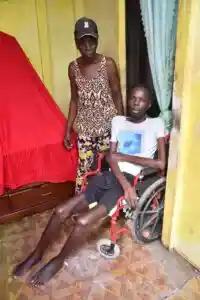

In the silent aftermath of Hurricane Melissa’s violent passage across northern Jamaica, one modest wooden home remains — scarred but standing — amid a sea of devastation in Royal Palm, St Ann. Inside, a mother and her four adult children, all wheelchair-bound, recount a night of dread, determination, and divine mercy.
Vera Brown is 65, a single mother with a spine bowed not only by age but by years of lifting, bathing, and caring for her immobile children — each of whom fell mysteriously ill as teens, their bodies gradually succumbing to a debilitating condition still undiagnosed despite decades of hospital visits and inconclusive tests.
As winds nearing 185 miles per hour clawed at the roof of her home, Vera summoned a strength she didn’t know she had. She moved from room to room, lifting and repositioning each of her children — not one of whom could walk — as zinc sheets peeled off overhead and debris crashed against the walls.
“I don’t know how I moved them all,” she said quietly. “I just knew I had to. Roofs can be fixed. My children can’t be replaced.”
A House Surrounded by Ruin
Around her, homes crumbled. Entire roofs flew like paper in the storm’s fury. Trees uprooted, fences splintered. But somehow, her board house endured — one of the few left standing in a battered stretch of the community.
Her daughter Norneth still struggles to describe the night.
“It felt like the house was about to lift off,” she said, staring at the plywood ceiling patched hurriedly after the storm. “We had to abandon one section of the house because the roof had gone. Everyone crowded into the other side where it was safer — if you could even call it that.”
But physical safety didn’t erase the deeper fear — the terrifying reality that escape was not an option. None of them could run. Not Vera. Not her children.
“It’s different for us. If something collapses, we can’t get out. My mom is the only one who can even try to move us. And she’s in pain every day.”
Pain and Purpose
That pain, Vera says, is constant. Her back, often inflamed, refuses to let her rest. Yet every day begins the same — lifting, feeding, dressing, guiding her children through narrow rooms in wheelchairs that barely fit. Her only relief comes from overseas relatives who occasionally send funds to help, but the demands never end.
Amoy, another of her daughters, broke down recalling her five-year-old son’s terror during the hurricane.
“He held onto me screaming, begging me not to let the wind take him. His schoolbooks got soaked. Everything gone. But at least he’s alive.”
The family’s eldest, Kenroy, sat by the doorway during the worst of it. He watched roofs disappear from neighboring homes. He saw a tree collapse and split a nearby house in half. Yet somehow, their humble structure endured.
“I don’t know how to explain it,” he said. “All I can say is God kept this house standing. I’ve seen concrete fall. But this little board house? Still here. That has to mean something.”
An Appeal for Relief
Their survival is not without cost. The roof is damaged. Supplies were lost. The family, already burdened by medical uncertainty, now faces reconstruction with no clear path forward.
“We need help — nails, roofing, school supplies, even clothes,” said Kenroy. “We’re grateful to be alive, but now we have to live.”
Their story is one of quiet courage — the kind that never trends, never makes the front page, but forms the backbone of resilience in every disaster. As Jamaica begins to rebuild from the hurricane’s fury, families like Vera’s represent the heart of that recovery.
They ask for little. Just enough to carry on.
And that is worth more than all the headlines.