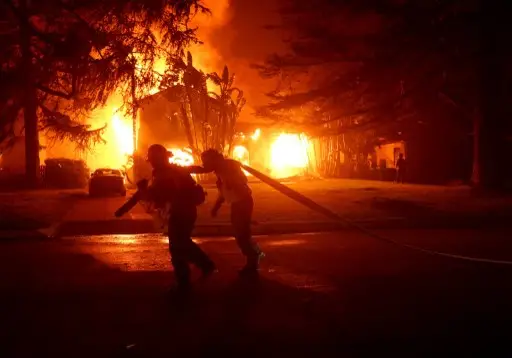


KATHMANDU — Smoke still hangs over Nepal’s capital, days after an explosion of fury swept through the streets. What began as anger over a social media blackout turned into an uprising that shattered the political order, forcing out a four-time prime minister and reducing the nation’s parliament building to ashes.
The scale was staggering. Jails burst open, releasing more than 13,000 inmates in a single night. Hotels, offices, and government compounds burned. Soldiers now enforce curfews under an uneasy silence, their armored vehicles stationed at every major junction.
A Generational Revolt
Unlike the party-driven protests of the past, this movement is led by Nepal’s restless youth. They are not marching under banners of ideology but under a banner of rejection—rejecting corruption, rejecting stale leadership, rejecting a parliament they see as illegitimate.
“Our demand is simple: no more recycled leaders,” said protester Sudan Gurung. “We don’t want their chairs. We want their system dismantled.”
For a country where one in five young people is unemployed, their revolt is as much economic as it is political.
Leadership Vacuum
With Prime Minister KP Sharma Oli’s abrupt resignation and disappearance, power has evaporated at the top. President Ramchandra Paudel remains, but even his own office was torched in the unrest. The old guard has largely gone to ground, creating space for new names to surface.
Former Chief Justice Sushila Karki, respected for her independence, has been floated as a caretaker figure. Kathmandu’s rapper-turned-mayor Balendra Shah has echoed support, signaling a rare alignment between activists and civic leaders.
A Nation on Edge
The army, once the enforcer of order, now doubles as mediator—meeting both generals and students in an attempt to stitch together a path forward. Yet uncertainty dominates. Few trust the political class, but divisions also run deep within the protest movement itself.
For now, the fires have dimmed. But Nepal stands suspended between collapse and rebirth—its next chapter likely to be written not in parliament, but in the streets.