

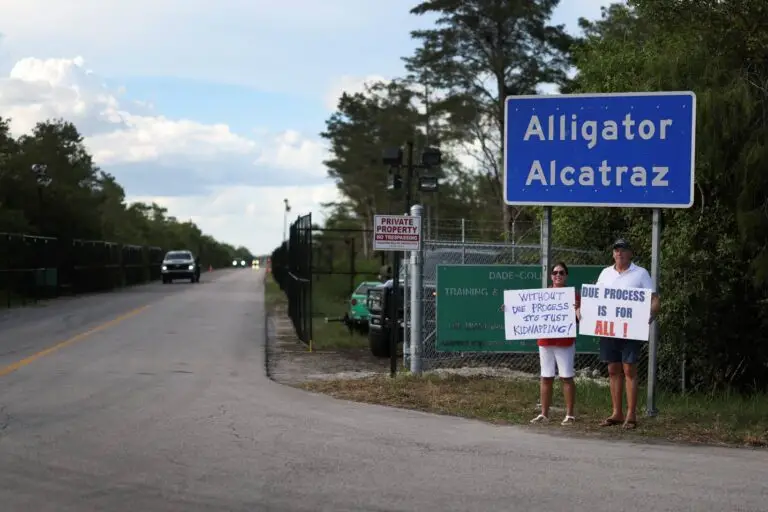

Miami, Florida — A federal appeals court has temporarily allowed a migrant detention camp in the Florida Everglades to continue operating, overturning a lower court order that sought to dismantle the controversial site.
The makeshift facility, informally dubbed “Alligator Alcatraz”, has been a flashpoint of political, legal, and environmental battles since its sudden construction earlier this summer. Built in just over a week on an abandoned airstrip deep in the wetlands, the camp was designed to house as many as 3,000 migrants under President Donald Trump’s aggressive deportation agenda.
Clash Between Courts and White House
Last month, a district judge ordered the closure of the camp, citing concerns over inadequate planning, lack of environmental reviews, and alleged violations of detainees’ rights. That ruling would have forced officials to halt new arrivals and dismantle the facility within 60 days.
On Thursday, however, a three-judge panel of the 11th Circuit Court of Appeals ruled that the site can remain operational while the administration pursues its appeal. The decision provides a temporary legal shield for the facility, pending further review.
Environmental Concerns and Legal Pushback
The location of the camp has drawn sharp criticism from conservation groups. Friends of the Everglades and the Center for Biological Diversity argue that the rushed construction ignored federal requirements for environmental impact studies and risks damaging a fragile ecosystem that is home to one of the largest alligator populations in the United States.
“The Everglades is no place for cages and tents,” the groups argued in court filings, warning of long-term ecological harm if the project proceeds unchecked.
Inside “Alligator Alcatraz”
Migrants detained at the site have described bleak conditions: overcrowded tents, limited medical attention, and reports of mistreatment. Human rights advocates say detainees’ legal protections are being trampled in the rush to expand detention capacity.
Trump, by contrast, has embraced the camp’s notoriety. During a high-profile visit shortly after its opening, he highlighted its austere environment and even joked that the surrounding alligators serve as a natural security force. The White House itself has leaned into the moniker “Alligator Alcatraz”, evoking imagery of the infamous San Francisco Bay prison.
What Comes Next
The temporary stay from the appeals court ensures that migrants will continue to be held at the Everglades site for the foreseeable future, while the legal battle over its fate unfolds. Homeland Security officials, led by Secretary Kristi Noem, have insisted the facility is essential to handling surging migrant numbers.
Critics counter that speed and political theatrics have come at the expense of human rights and environmental safeguards. With the case still in motion, the ultimate fate of “Alligator Alcatraz” remains uncertain — but for now, its gates remain open.