
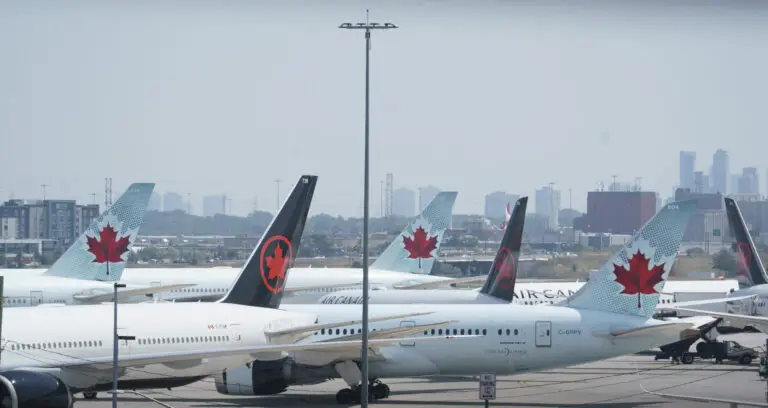

The wave of grounded flights that paralyzed Air Canada’s network over the weekend is beginning to lift—though only after Ottawa stepped in and ordered the airline’s 10,000 striking flight attendants back to work.
Flights are expected to resume Sunday evening, but Canada’s largest carrier acknowledged the disruption will echo for at least a week as schedules, crews, and equipment are slowly restored.
Strike Broken by Law, Not Negotiation
The walkout, launched over pay disputes and compensation for unpaid duties, barely lasted a day before the federal government intervened. Invoking emergency powers under the Canada Labour Code, the Canada Industrial Relations Board (CIRB) compelled cabin crew to return to duty and forced both parties into binding arbitration.
The intervention instantly ended a work stoppage that had already canceled hundreds of flights and stranded passengers at airports across the country and abroad.
Union Cries Foul, Alleging Bias and Precedent
The Canadian Union of Public Employees (CUPE), representing the flight attendants, denounced the government’s move as a betrayal of collective bargaining rights. Union leaders argue that the ruling effectively hands victory to the airline without requiring compromise.
Tensions deepened after CUPE accused CIRB chair Maryse Tremblay—formerly legal counsel for Air Canada—of presiding over a conflict of interest in ordering the strike’s termination.
“This is a dangerous precedent,” the union declared, warning that it diminishes the credibility of arbitration as a fair process.
Economic Stakes Loom Large
Air Canada’s stoppage carried implications beyond grounded passengers. The airline moves more than 130,000 travelers daily and is a critical artery for trade and tourism. Business leaders had already warned the shutdown risked amplifying the economic drag caused by global tariffs and inflation.
The Business Council of Canada, days before the strike began, flagged the potential fallout as “severe” given the airline’s centrality to cross-border commerce.
Pay Dispute Still Unsettled
Though flights are airborne again, the central issue—wages—remains unresolved. Air Canada argues its pay package would lift senior cabin crew to average annual earnings of CAD $87,000 by 2027. CUPE rejects the claim, saying the offer lags behind inflation and international standards.
For now, the battle has shifted from picket lines to arbitration chambers. Passengers, however, will continue to feel the turbulence as the carrier works to clear a backlog of stranded travelers and recalibrate its network.