
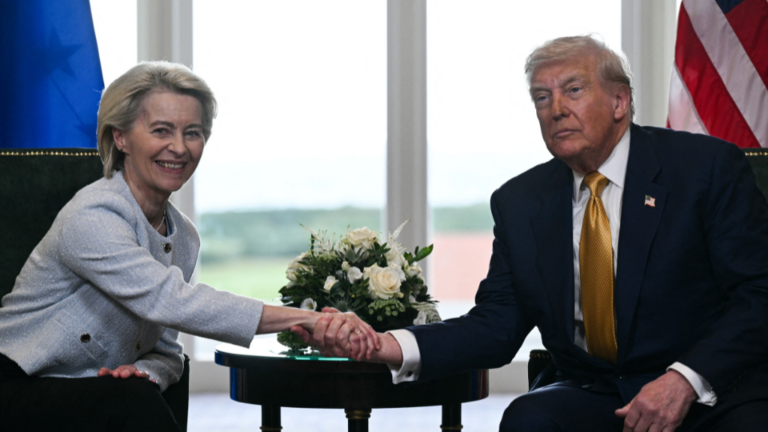

TURNBERRY, Scotland — In an eleventh-hour breakthrough on Sunday, U.S. President Donald Trump and European Commission President Ursula von der Leyen agreed to cap American duties on European goods at 15 percent, defusing tensions that were days away from igniting a trans-Atlantic tariff escalation.
Meeting for just under an hour at Trump’s coastal golf resort, the two leaders replaced the White House’s threatened 30-percent blanket levy with the lower ceiling. The arrangement spares a $1.9 trillion trade relationship from sliding into open hostilities while still leaving European exporters—especially automakers, drug manufacturers and chipmakers—facing steeper costs than before the dispute began.
In exchange, the European Union pledged to:
- Buy $750 billion in U.S. energy products—liquefied natural gas, oil and nuclear fuels—over three years as it seeks alternatives to Russian supply.
- Channel roughly $600 billion in additional investment into the United States, targeting critical raw materials and advanced manufacturing.
- Open tariff-free corridors for select “strategic” categories, including commercial aircraft, specialty chemicals, certain farm goods and key minerals.
Von der Leyen called the compromise “significant,” adding that it “restores stability and predictability for companies on both sides of the ocean.” She hinted that Brussels will push for further “zero-for-zero” pacts—starting with alcoholic beverages—before the summer is out.
Trump, declaring the result “probably the largest deal ever reached,” said EU governments also intend to order “hundreds of billions of dollars” in U.S. defense hardware as they expand NATO budgets.
What Stays and What Shifts
- Steel and aluminium: Existing surcharges of 50 percent remain, though EU negotiators say a quota-and-tariff blend will replace flat rates once technical details are finalised.
- Automobiles: The 15-percent ceiling applies across the board, moderating but not eliminating the stiff duties German and French manufacturers face.
- Fallback threats: Brussels had authorised retaliatory duties on $109 billion of American exports—ranging from aircraft to whiskey—to kick in on August 7. Those measures are now shelved, pending member-state approval of Sunday’s accord.
German Chancellor Friedrich Merz was first to applaud the outcome, calling it “a sensible reset” that prevents “a needless spiral.” Even so, von der Leyen conceded that “15 percent is not trivial, but it is the most pragmatic path available.”
Next Steps
The deal now heads to EU national capitals for ratification and to Congress for review of any legislative tweaks. Both leaders signalled confidence that it will clear those hurdles quickly.
Asked which trading partner is next in line for negotiations, Trump shrugged: “This was the big one. Everything else will be smaller potatoes.”
The Atlantic, for now, remains a trading lane rather than a battleground.