

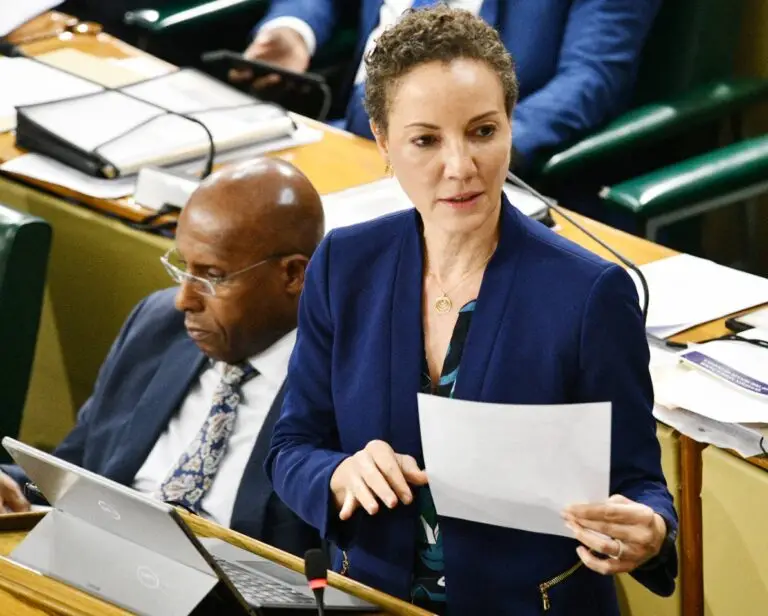

Friday’s sitting of the Senate, set aside for three companion crime-control amendments, turned into a high-stakes political audition as both sides tried to claim ownership of Jamaica’s sharp fall in homicides.
Legislation in brief — but that’s not what stole the show
- Offences Against the Person (Amendment) Act 2025 – lengthens minimum prison terms for murder and designates harsher penalties when the victim is a child.
- Child Care and Protection (Amendment) Act 2025 – keeps juvenile sentencing caps in place even if an accused turns 18 before trial.
- Criminal Justice (Administration) (Amendment) Act 2025 – aligns parole eligibility with the stiffer timelines above.
Although all three Bills cleared the Upper House with only minor tweaks, the debate itself quickly veered into a statistical sword-fight over who deserves credit for the country’s 44 per-cent year-to-date reduction in murders.
Government’s pitch: “Performance, not prayer”
Government Senator Charles Sinclair argued that an $80-billion modernisation drive for the Jamaica Constabulary Force (JCF) — from ballistic labs to renovated stations — is the reason murders are down. For Sinclair, that data point alone is a referendum on leadership: keep Prime Minister Andrew Holness and National Security Minister Dr Horace Chang at the helm.
Opposition’s counter: “Context, not cherry-picking”
Opposition lead spokesman Peter Bunting fired back with a longer lens. He tallied more than 12,000 murders since the Jamaica Labour Party (JLP) took office in 2016 and warned colleagues against “falling in love with a six-month snapshot.” Bunting credited the current dip to Commissioner Dr Kevin Blake’s operational resets after routine States of Emergency were retired, not to Cabinet policy.
Fresh face, old grievance
First-time Government senator Abka Fitz-Henley dismissed Bunting’s argument as “statistical hopscotch,” invoking the 13,000-plus murders recorded during four consecutive People’s National Party (PNP) terms from 1989 to 2005. His bottom line: investment and continuity are finally bridging Jamaica’s long-standing enforcement gap, and reversing course would be reckless.
Election undertone grows louder
Opposition Senator Lambert Brown ignored the ledger sheets altogether, predicting voters will make their own judgment soon enough: “Every week you stall the election clock, the swing gets harder.”
Why this matters beyond the theatrics
- Policy durability: Both parties now tacitly support longer sentences for murder — signalling a rare bipartisan consensus on punishment, even if they disagree on credit.
- Institutional clarity: The amendments lock in separate sentencing tracks for juveniles versus adults, preventing case-by-case improvisation by the courts.
- Political framing: Crime stats have become the shorthand metric for leadership. Expect both parties’ campaign ads to open with homicide graphs rather than manifesto pages.
Bottom line: the Bills passed, but the real vote will happen at the polls. Until then, each fresh crime figure will be weaponised either as proof of momentum or evidence of mismanagement — and every Senate session will double as a dress rehearsal for Election Day.