

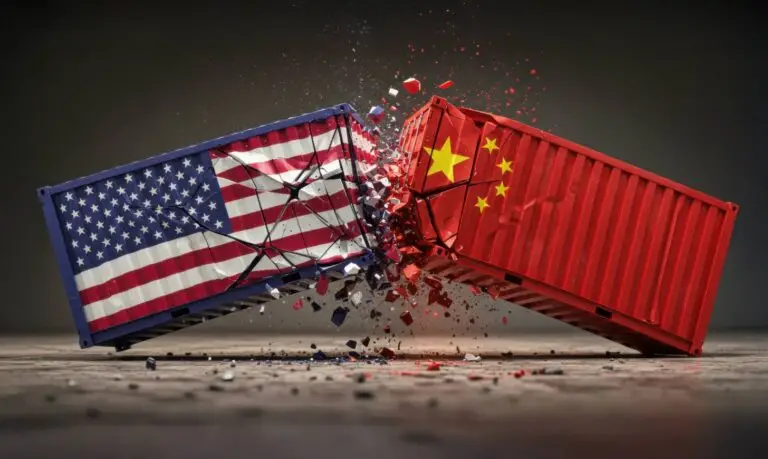

WASHINGTON, D.C. — The United States and China have agreed to sharply roll back the punitive tariffs that have dominated their economic relationship, pledging a 90‑day freeze on further escalation while negotiators search for a broader settlement.
In a joint communiqué issued late Monday after marathon talks in Geneva, both sides committed to cutting their triple‑digit import fees to more manageable levels. Under the arrangement, U.S. duties on Chinese goods will fall to 30 percent, while China will trim its retaliatory levies to 10 percent by mid‑week.
The breakthrough jolted Wall Street out of its month‑long slump: the S&P 500 leapt 3.3 percent, and risk‑sensitive assets worldwide followed suit.
“We’ve hit the reset button,” President Donald Trump told reporters, adding that he expects to speak directly with President Xi Jinping “before the week is out.”
Treasury Secretary Scott Bessent, who led the U.S. delegation, described the conversations with Chinese Vice Premier He Lifeng and trade envoy Li Chenggang as “frank, detailed, and ultimately productive.” He confirmed that follow‑up sessions are already being scheduled.
A Shift From Confrontation to Dialogue
Since the White House launched its sweeping tariff blitz last month—raising U.S. rates on some Chinese products as high as 145 percent—Beijing has retaliated in kind, pushing its own surcharges up to 125 percent. Monday’s accord represents the first sign of de‑escalation.
Chinese officials hailed the outcome as “substantial progress that serves both nations and the global economy,” and voiced hope that Washington will “continue correcting the unilateral tariff hikes.” Beijing also agreed to suspend an array of non‑tariff countermeasures and to create an ongoing consultation mechanism.
Sticking Points Remain
Notably, a 20 percent U.S. surcharge aimed at Chinese chemical exports tied to fentanyl production will stay in place for now. U.S. Trade Representative Jamieson Greer said both capitals had “outlined a constructive path forward” on narcotics cooperation but offered no timeline for lifting the extra charge.
Bessent cautioned that the administration still favors “targeted decoupling where strategic interests demand it,” and conceded that non‑tariff barriers harming American firms are still under review.
Market Relief — but No Guarantees
Analysts welcomed the truce but warned of fragile foundations. “This is a meaningful de‑escalation, yet the 90‑day clock can just as easily restart the confrontation,” said Mark Williams of Capital Economics. Deutsche Bank strategists called the mood “tentatively conciliatory,” while Pinpoint Asset Management’s Zhiwei Zhang argued that Beijing had secured major tariff relief “without obvious concessions.”
For now, investors are betting the détente will hold—at least long enough for negotiators to craft the “fulsome agreement” Bessent says both sides want.
The Geneva breakthrough comes on the heels of Washington’s fresh trade pact with the United Kingdom, hinting that the administration is keen to notch a series of deals after a turbulent month of tariff brinkmanship.
Whether the current pause blossoms into lasting peace or merely postpones the next volley of duties will become clear in the weeks ahead, as American and Chinese teams return to the table in Washington, Beijing, or a neutral venue yet to be named.